


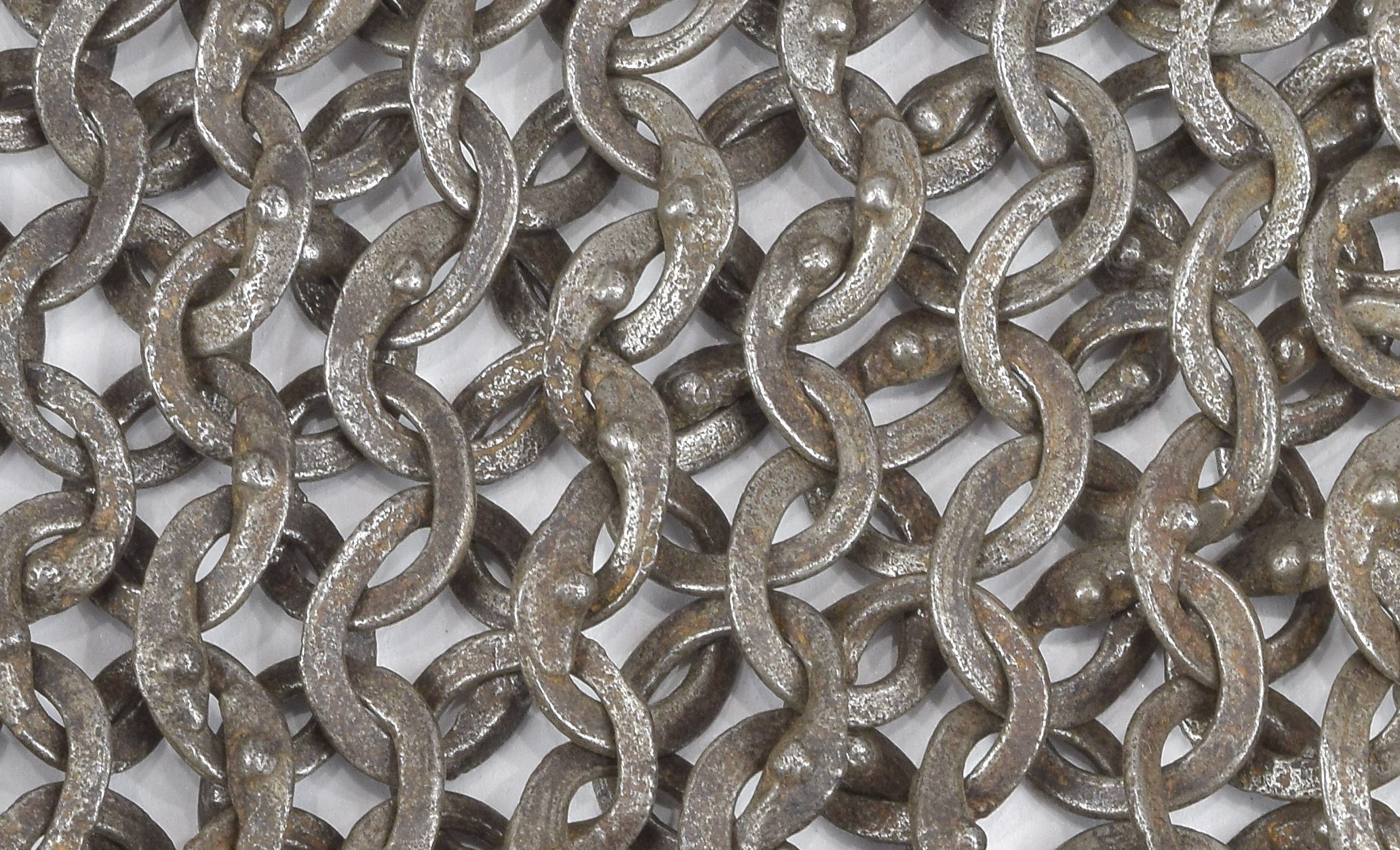


Mail shirt 15th century
European. Crotch length body with long sleeves. Opens in the front. Sleeves with elbow bends and tapers in the upper arm and forearm. Arms joined to the body with a row of cross-linked rings at the armpit. There are 13 rings in the body connected by 7 cross-linked rings to 8 rings in the sleeve at this join. Tailored in the back to the shoulders with expansion from the shoulder to the shoulder blades and taper back to the waist. Small extension to the center back that can be pulled up and connected to the short section at the bottom of the left side to form a brayette. There is some expansion leading to this extension that allows the mail to fit to the buttocks. Right sleeve with a narrow cuff formed of 5 rows of much finer mail formed of round wire with wedge rivets also forming a pent roof. Formed of large mostly flat slightly oval rings, secured by wedge rivets with pent roof form at the overlaps. Rings tapering in size somewhat in size from the chest to the wrists and skirt. Some old repairs, assembly or modifications with smaller riveted links. Some minor areas of repair with modern butted links. Left forearm appears to be patched with a forearm from another shirt or sleeve as the wrists don't match and there seems to be one almost full row of butted rings. The repair is formed of nearly identical rings with correct taper, so was from an appropriate piece, not just a random swatch. Tailoring in the back of the body consists of 9 expansions on each side at the shoulder which then lead to 9 contractions back to the waist (10 on the left side). There are two additional rings in the center of the back that provide additional contraction, and two more near inside the base of the right contractions. There appears to be one spurious expansion as well. Below the waist, just right of center, there is a single line of 8 expansions which would allow the piece to fit to the buttocks. The shoulder expansions add a ring every even row. The contractions remove one every other even row, then the below waist expansions are also every other even row. There is also tailoring in the front of the shoulder. There are 7 expansions on the left and 9 on the right. The cross grain join at the armpit is 7 rings long (counted on the left). Expansions are marked with white flags, newer images at the top show the most complete map, lower images were taken earlier, before all tailoring was found.
The style of the rings indicates a date in the first half of the 15th century. Many of the surviving shirts with brayette extensions are dated to the second half of the 15th century. All of these are associated with German manufacture, the ones which have identification rings are from Nuremberg.
Old rectangular brass collection tag at the neck marked 25.135.56.
The pictures of the shirt on the mannequin body show the tailoring in the back of the shirt and approximate how it might hang. The shoulders and arms do not have proper support, so the arms should likely hang higher. The picture of the shirt with a cape and sword shows how the shirt was displayed in a previous collection.
Objectively the rings appear "large," and "flat." They appear to be much larger than those often found on separate sleeves and the outside face does appear flat except at the area of the rivet overlap. The back (inside) is much more rounded, so the rings really aren't flat, they are more "D" shaped. Actual measurements of a ring at the edge of the front opening near the top: Outside diameter 10mm x 10.6mm. Inside diameter 6.1mm x 7.5mm. Thickness 0.9mm rising to 2.1mm at the point of the rivet. Measurements of a ring on the lower edge at the right side: Outside diameter 9.7mm x 11mm, inside diameter 5.6mm x 8.0mm, thickness .07mm. Measurements of a ring at the cuff on the right sleeve: outside diameter 8.4mm x 8.8mm, inside diameter 5.8mm x 6.3mm, wire diameter 1.1mm.
Tom Biliter assembled a list of the known similar shirts. This group is defined by the rear flap that can be drawn up and connected to the front to form an integral brayette. Most of these open at the front, appear to have an overlap at the front, have or would have had long sleeves and they are generally dated to the second half of the 15th century. They include:
Assuming the flap is complete, the form of the bottom edge would fit closely at the rear covering just the buttocks closely and then extend around the front forming a short skirt that would end at app. the hip joint. If we assume that this mimics the skirt line of the corresponding civilian clothing, this would date to the mid to late 15th c.
Note: The style of the brass collection tag and numbering scheme resembles those used by the Met. Unfortunately, this number is associated with a mid 16th c. close helmet, not a shirt of mail. So either the tag has changed items, or it comes from a different institution with a similar numbering scheme. A short summary of the investigation involved here. The seller indicated that the shirt probably came from Hearst. Maybe. I contacted Dr. Chassica Kirchhoff to see whether the tag might be a Hearst tag since the DIA has a number of Hearst pieces. She told me that the Hearst tags are different (round and paper) but that the tag and numbering scheme looked like Met tags and numbers (before she moved to the DIA she worked at the Met). I tried to look up the number in the online database. It did not appear. Many pieces that have been sold are not in the online database. Donald LaRocca looked the number up in the card catalogue that contains the old records and found that it was associated with a close helmet that was sold in the 1950's.
Weight: 15 pounds 13.8 ounces (7195g).
Provenance: unnamed 1993 to 2023, Bill Scollard (1933-2018). I have a copy of a receipt from William Scollard that indicates that the shirt (or a shirt sold in 1993) came from the Bashford Dean collection.
If you have any questions, please send them to Wade Allen
This site last updated Mon Feb 23 18:26:29 EST 2026